







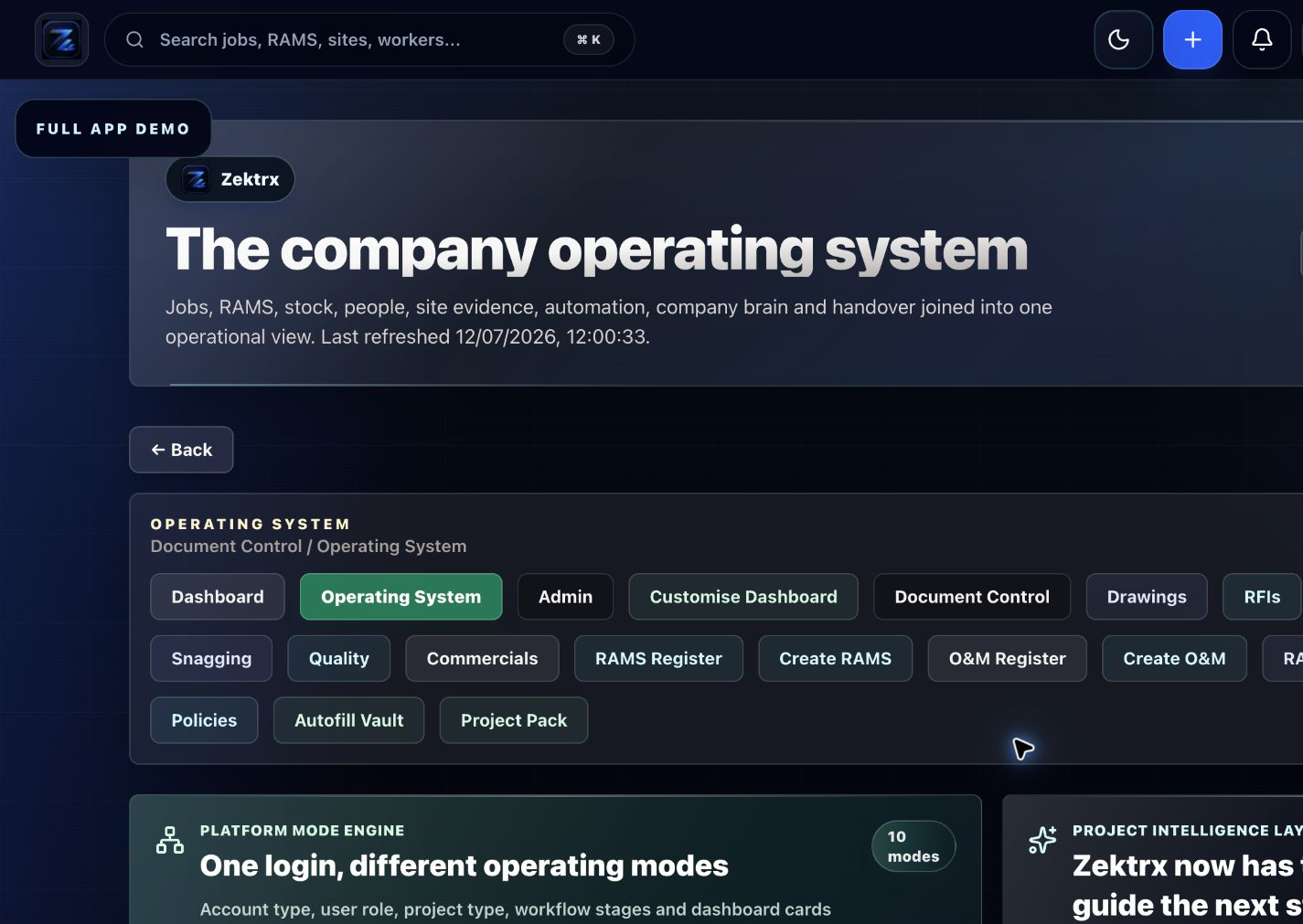
Plan
Move the article into an operating plan.
Good guidance should become owned work, review points and clear next actions inside the contractor workspace.
Guide to connecting RAMS, drawings, RFIs, site diary, snagging, documents, quality, workforce, procurement, commercials and AI project manager workflows.
Industry News
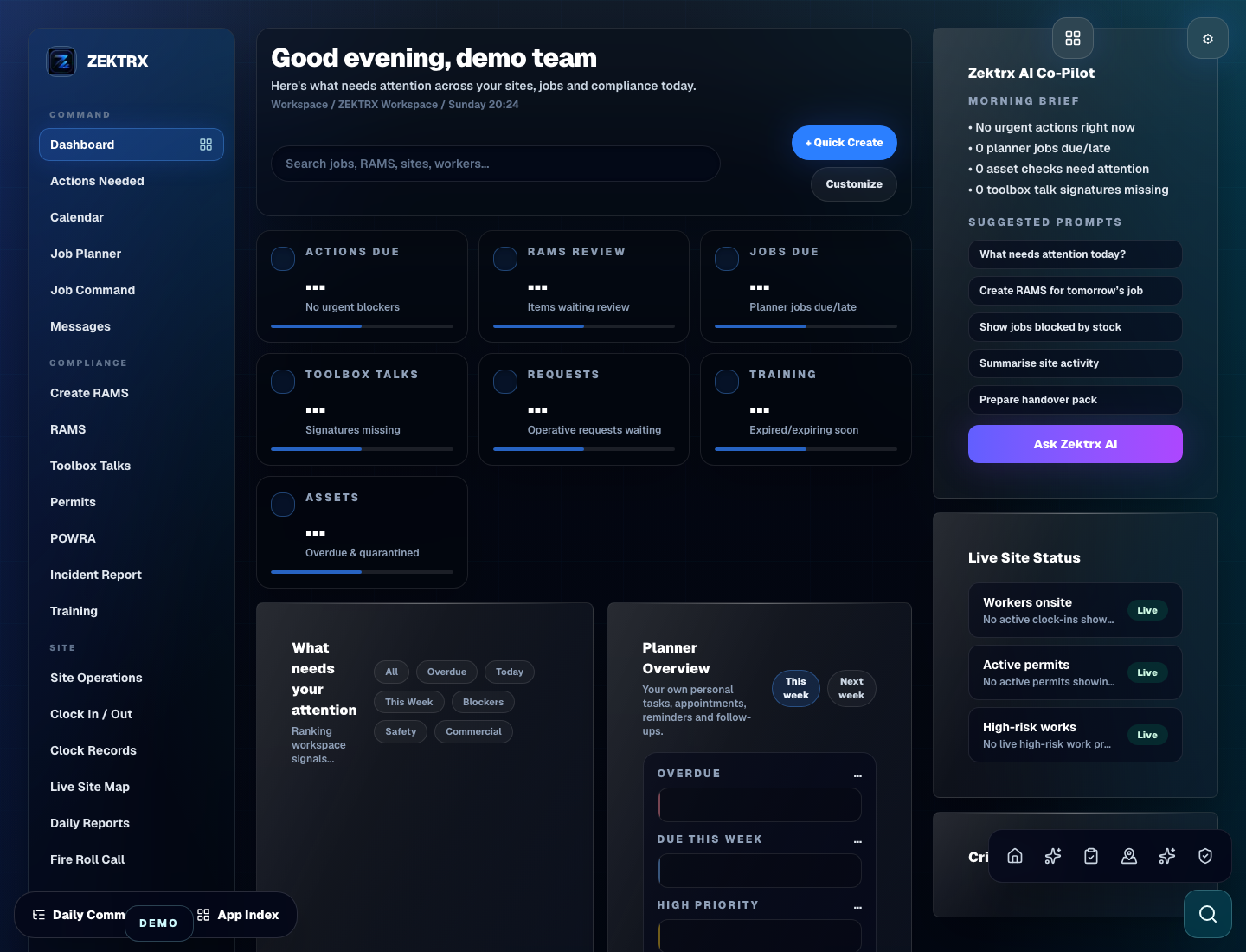
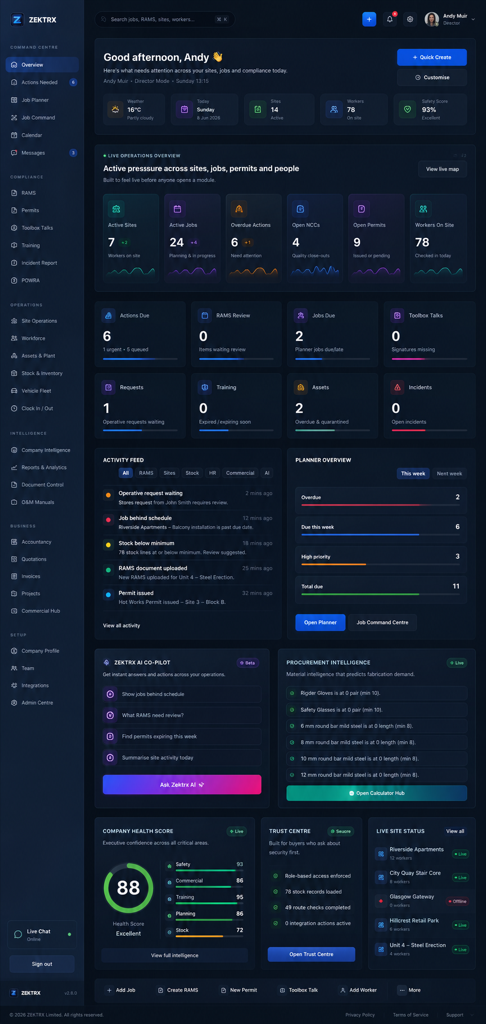
This resource should not sit apart from the product. Zektrx connects the guidance to planning, controlled records and review-ready evidence so teams can act on it.
Plan
Good guidance should become owned work, review points and clear next actions inside the contractor workspace.
Control
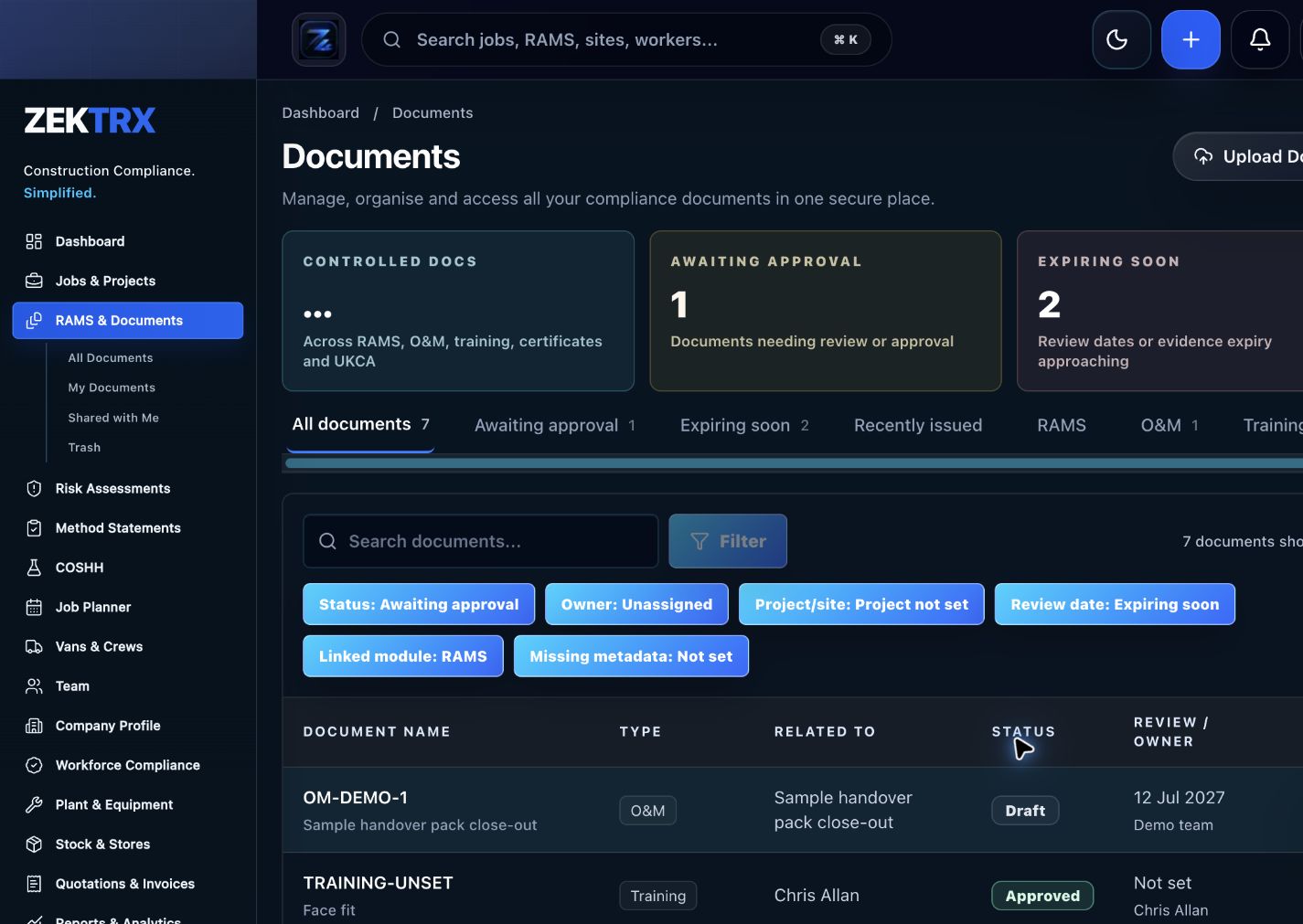
The resource should point into controlled records, current versions, approvals and the proof teams need later.
Review
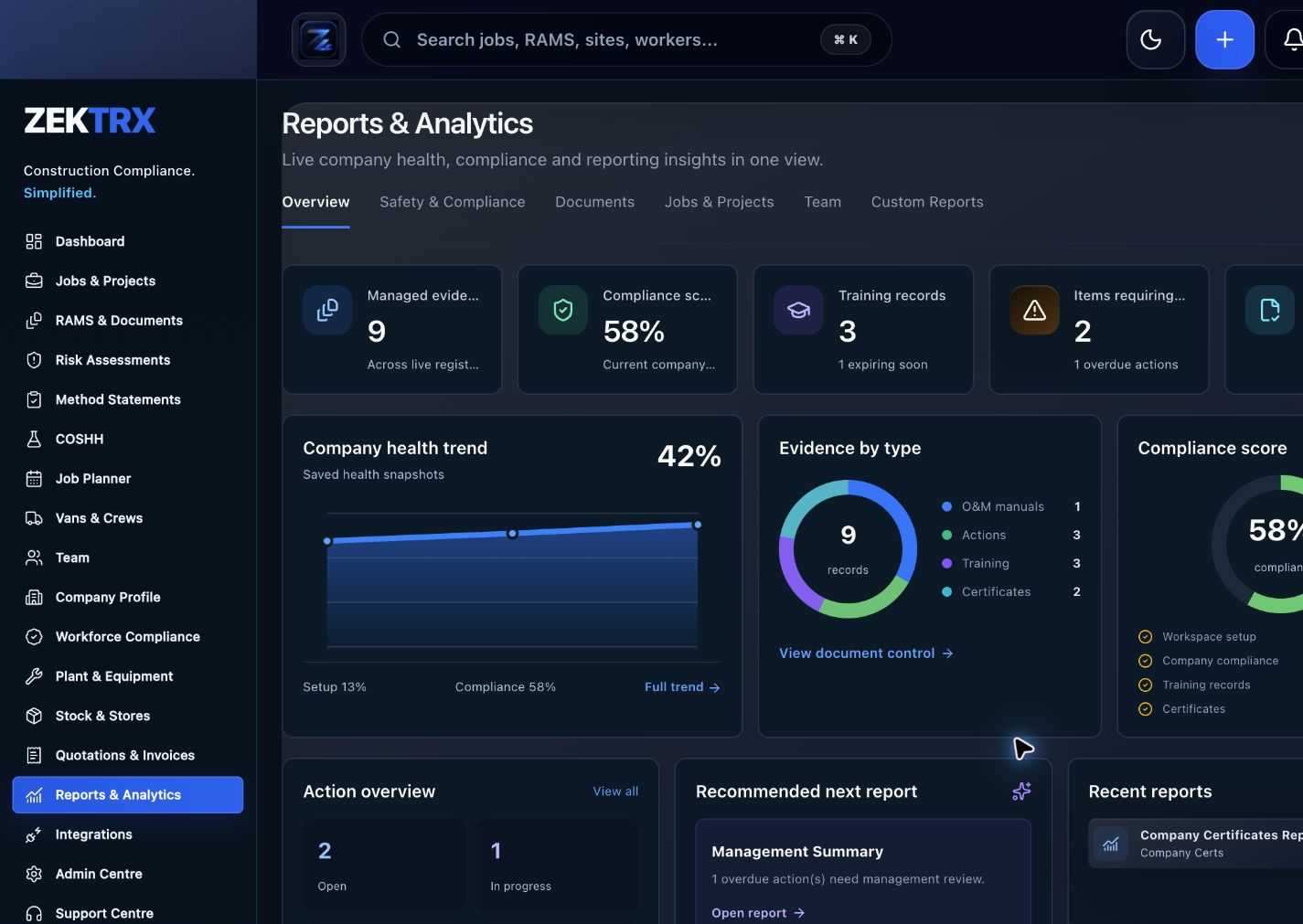
Reports and audit packs make the article practical after the work is complete, not just useful while reading.
Review the topic, reading time, editorial status and related Zektrx workflows before moving into the detailed guidance.
Topic
Industry News
Reading path
5 article sections
Review status
Published 24 June 2026
Connected links
Project Management Workspace
Construction project teams often use one tool for RAMS, another for drawings, another for RFIs and another for commercial records. That can work for small jobs, but it becomes fragile when the project needs joined-up reporting.
Connected modules help the team see how a drawing change affects RFIs, RAMS, site actions, procurement, quality and handover.
The point is not to add more admin screens. The point is to keep each record tied to the same project context, permission model and audit trail.
AI is most useful when it can summarise live project context and suggest practical next actions. Useful prompts include:
The output still needs review. AI can help organise and prioritise information, but project decisions should remain owned by the team.
If the AI layer cannot see the right records, it becomes another disconnected assistant. If it can see controlled project records, it can help the team understand risk, missing evidence and next steps faster.
That is why connected modules matter. They give the AI Project Manager a cleaner source of truth.
Zektrx connects project modules around RAMS, drawings, RFIs, site diary, snagging, documents, submittals, quality, workforce, equipment, procurement, commercials, client access and AI guidance. The aim is practical project control, not another isolated task list.
Related Zektrx workflow
Put it into practice
Start with the £5 for 14 days trial, then connect RAMS, jobs, stock, documents, records and reporting in one place.
1. Learn
A practical guide to AI RAMS, drawing review, RFIs, site diaries, O&M packs and action lists in contractor workflows.
Industry news style guidance on using AI to support RAMS drafting while keeping competent review and site-specific checks in place.
A practical guide to construction cloud software for contractors managing jobs, documents, RAMS, site evidence and reporting online.
2. Use
Estimate ductwork sheet material from duct surface area, material rate and waste allowance. Free online tool for UK construction and trade teams.
Estimate rectangular load weight from length, width, thickness and density before lifting-plan review. Free online tool for UK construction and trade teams.
Estimate reinforcement bar count, total length and weight for a simple slab grid. Free online tool for UK construction and trade teams.
3. Automate
Connect mechanical RAMS, plant records, documents, inspections and handover.
Connect RAMS, incidents, training, permits, inspections and safety evidence.
Manage roofing RAMS, work-at-height evidence, photos and handover records.
4. Start
Move from static documents into controlled RAMS with review, signatures, revisions and evidence.
Create RAMSRelated Guides
A practical guide to AI RAMS, drawing review, RFIs, site diaries, O&M packs and action lists in contractor workflows.
Industry news style guidance on using AI to support RAMS drafting while keeping competent review and site-specific checks in place.
A practical guide to construction cloud software for contractors managing jobs, documents, RAMS, site evidence and reporting online.
Related Calculators
Estimate ductwork sheet material from duct surface area, material rate and waste allowance. Free online tool for UK construction and trade teams.
Estimate rectangular load weight from length, width, thickness and density before lifting-plan review. Free online tool for UK construction and trade teams.
Estimate reinforcement bar count, total length and weight for a simple slab grid. Free online tool for UK construction and trade teams.
Related Templates
Check equipment condition, guards, inspections, certificates, defects and safe use controls. Free printable construction template from Zektrx.
Track snags, defects, locations, owners, photos, due dates and close-out sign-off. Free printable construction template from Zektrx.
Check waste, spill controls, noise, dust, drainage, storage and environmental actions. Free printable construction template from Zektrx.
Related Features
Connect mechanical RAMS, plant records, documents, inspections and handover.
Connect RAMS, incidents, training, permits, inspections and safety evidence.
Manage roofing RAMS, work-at-height evidence, photos and handover records.
Related Industries
Groundworks RAMS, permits, site diaries, plant checks, photos, quality records and delay evidence. One platform for documents, evidence and compliance.
Mechanical contractor RAMS, permits, plant records, drawings, inspections and handover workflows. One platform for documents, evidence and compliance.
Scaffolding contractor RAMS, inspections, handover certificates, permits, photos and site evidence. One platform for documents, evidence and compliance.
Related Comparisons
Compare Zektrx with SafetyCulture for contractors that need inspections plus RAMS, permits, documents, actions, site diaries and construction evidence packs.
A construction management software buyer guide for teams comparing project controls, site records, documents, compliance and contractor operations.
Compare Zektrx with Procore for contractors that need RAMS, site evidence, document control and day-to-day trade operations without enterprise complexity.
Related FAQs
Yes. Site diary workflows can capture labour, weather, progress, conditions, delays and evidence.
From Groundworkers Software
Yes. Equipment and service workflows can support reminders and evidence.
From Groundworkers Software
Yes. Diary and evidence records can support delay reporting.
From Groundworkers Software
Yes. O&M, document and evidence workflows can support mechanical handover packs.
From Mechanical Contractors Software
This resource is for contractor, site, compliance and operations teams reviewing connected project modules and ai project manager guide and deciding which records should become controlled workflows.
Yes. Zektrx is designed to turn recurring construction checklists, documents, actions, signatures and evidence into connected workflows.
No. Use this as practical workflow guidance and keep competent legal, safety, engineering or site-specific review where required.