







Plan
Move the article into an operating plan.
Good guidance should become owned work, review points and clear next actions inside the contractor workspace.
A practical checklist for keeping pedestrians, vehicles, deliveries, turning areas and visibility safer on construction sites.
Safety Articles
This resource should not sit apart from the product. Zektrx connects the guidance to planning, controlled records and review-ready evidence so teams can act on it.
Plan
Good guidance should become owned work, review points and clear next actions inside the contractor workspace.
Control
The resource should point into controlled records, current versions, approvals and the proof teams need later.
Review
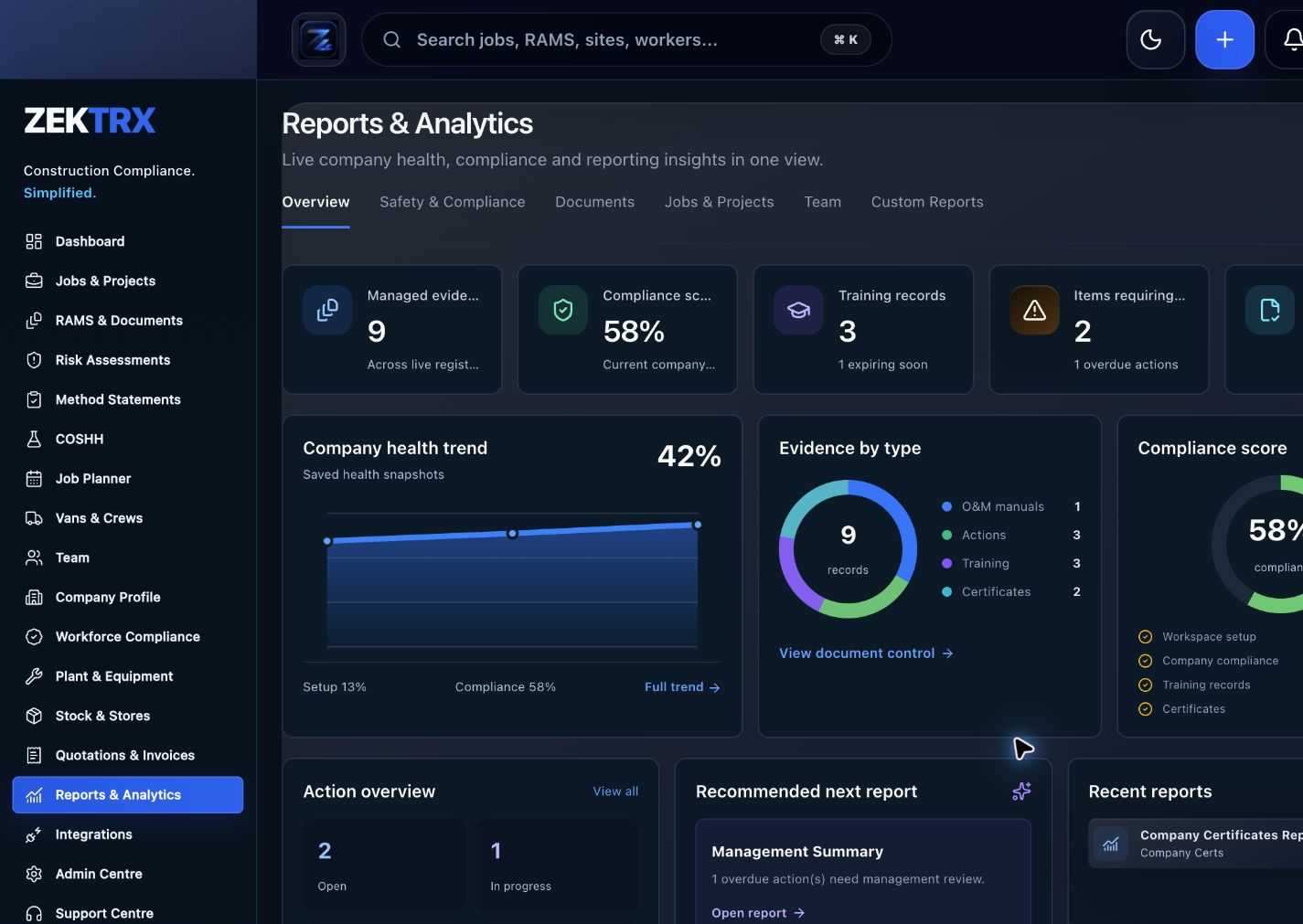
Reports and audit packs make the article practical after the work is complete, not just useful while reading.
Review the topic, reading time, editorial status and related Zektrx workflows before moving into the detailed guidance.
Topic
Safety Articles
Reading path
5 article sections
Review status
Published 5 July 2026
Connected links
Site Operations Software
Site traffic risk changes as the project changes. Groundworks, deliveries, fit-out, waste removal and handover can all create different pedestrian and vehicle conflicts.
Traffic planning should start before vehicles arrive, then be reviewed when the layout, access, storage areas or work sequence changes.
Pedestrian and vehicle separation is one of the clearest controls. Where separation is not possible, the task needs tighter planning, communication and supervision.
A traffic plan is only useful if it matches the live site. If a gate closes, a scaffold blocks a walkway or a delivery area moves, update the record and brief the affected teams.
Photos can be useful evidence, especially where routes, barriers and signage are changed during the job.
Review HSE traffic management on site guidance for more detail on vehicle routes, pedestrian separation, visibility and instructions.
Zektrx helps contractors connect traffic checks, route changes, delivery notes, briefings, photos and actions to the job plan. That gives supervisors a clearer way to manage movement around the site as conditions change.
Related Zektrx workflow
Put it into practice
Start with the £5 for 14 days trial, then connect RAMS, jobs, stock, documents, records and reporting in one place.
1. Learn
A practical asbestos awareness guide for checking records, stopping work, escalating concerns and keeping evidence before site work starts.
A plain-English awareness guide on asbestosis, why asbestos exposure records matter and when workers should seek medical advice.
Practical site safety tips for turning daily briefings, inspections, actions and evidence into a usable contractor record.
2. Use
Screen work-at-height task risk using height, duration, people and control rating. Free online tool for UK construction and trade teams.
Estimate hand-arm vibration A(8) exposure from vibration magnitude and trigger time. Free online tool for UK construction and trade teams.
Check ladder angle and vertical reach using ladder length and wall distance. Free online tool for UK construction and trade teams.
3. Automate
Connect RAMS, incidents, training, permits, inspections and safety evidence.
Manage safety records, briefings, incidents, actions and evidence for contractors.
Plan toolbox talks, capture attendance and keep briefing evidence with the job.
4. Start
Use Zektrx to add owners, review dates, evidence, signatures, actions and reporting.
Start Trial in ZektrxRelated Guides
A practical asbestos awareness guide for checking records, stopping work, escalating concerns and keeping evidence before site work starts.
A plain-English awareness guide on asbestosis, why asbestos exposure records matter and when workers should seek medical advice.
Practical site safety tips for turning daily briefings, inspections, actions and evidence into a usable contractor record.
Related Calculators
Screen work-at-height task risk using height, duration, people and control rating. Free online tool for UK construction and trade teams.
Estimate hand-arm vibration A(8) exposure from vibration magnitude and trigger time. Free online tool for UK construction and trade teams.
Check ladder angle and vertical reach using ladder length and wall distance. Free online tool for UK construction and trade teams.
Related Templates
Plan briefing topics, attendance, signatures, follow-up questions and evidence. Free printable construction template from Zektrx.
Control permit scope, hazards, isolations, approvals, handback and close-out checks. Free printable construction template from Zektrx.
Capture incident details, injuries, witnesses, photos, immediate actions and investigation notes. Free printable construction template from Zektrx.
Related Features
Connect RAMS, incidents, training, permits, inspections and safety evidence.
Manage safety records, briefings, incidents, actions and evidence for contractors.
Plan toolbox talks, capture attendance and keep briefing evidence with the job.
Related Industries
Roofing contractor RAMS, work-at-height controls, permits, photos, site records and client evidence.
Scaffolding contractor RAMS, inspections, handover certificates, permits, photos and site evidence. One platform for documents, evidence and compliance.
Electrical contractor RAMS, permits, testing evidence, drawings, site records and handover packs. One platform for documents, evidence and compliance.
Related Comparisons
A practical buyer guide for choosing RAMS software that supports risk assessments, method statements, revisions, signatures and site evidence.
Compare Zektrx with SafetyCulture for contractors that need inspections plus RAMS, permits, documents, actions, site diaries and construction evidence packs.
Compare Zektrx with paper RAMS and Word/PDF RAMS packs for contractors that need signatures, revisions, review evidence and site acceptance.
Related FAQs
Attendance evidence is useful for audit trails and proving workers were briefed.
From Toolbox Talk Template
Yes. Editable toolbox talks can keep attendance and evidence with the project.
From Toolbox Talk Template
Permit rules depend on the site and task, but often include hot works, electrical isolation, confined spaces and high-risk maintenance.
From Permit to Work Template
Yes. Editable permit workflows can capture approvals, evidence and handback.
From Permit to Work Template
This resource is for contractor, site, compliance and operations teams reviewing construction site traffic safety checklist and deciding which records should become controlled workflows.
Yes. Zektrx is designed to turn recurring construction checklists, documents, actions, signatures and evidence into connected workflows.
No. Use this as practical workflow guidance and keep competent legal, safety, engineering or site-specific review where required.