







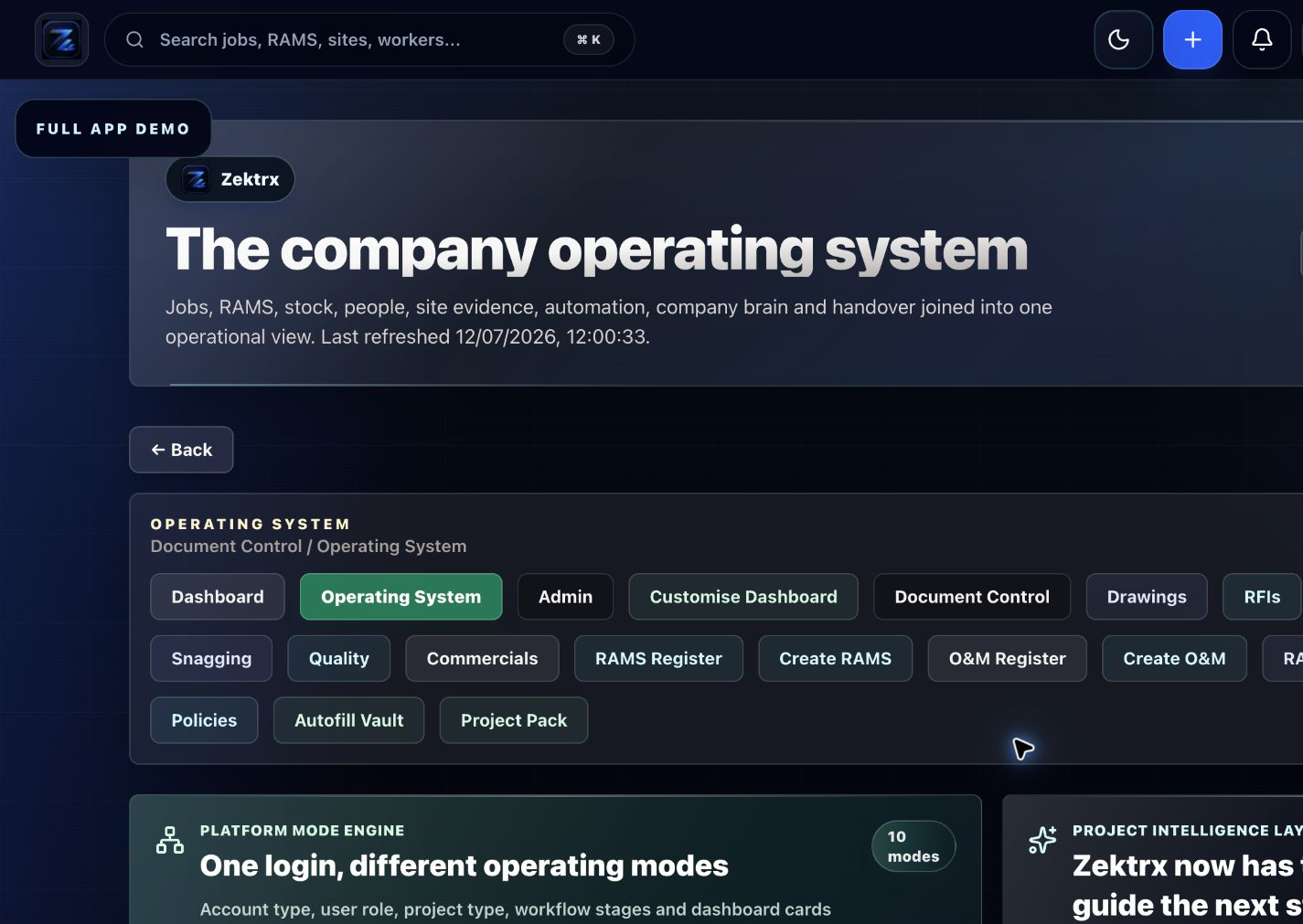
Plan
Move the article into an operating plan.
Good guidance should become owned work, review points and clear next actions inside the contractor workspace.
Use method statement software to control work steps, risk links, review status, client comments, signatures and revision history.
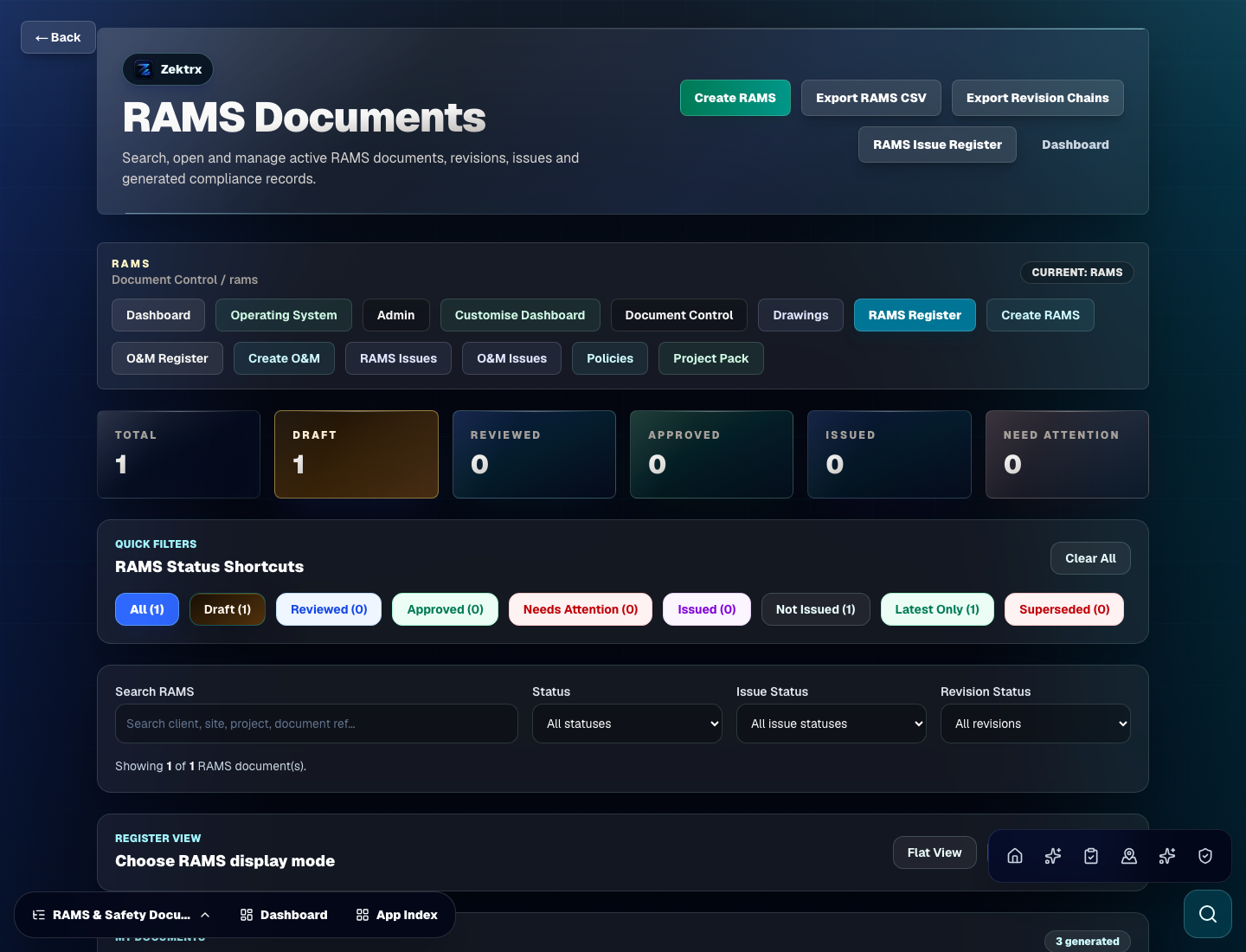
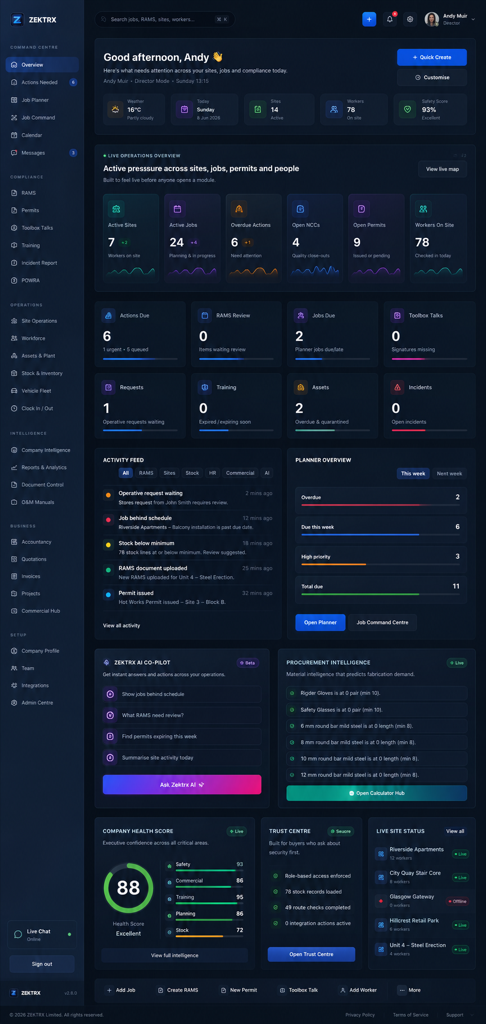
RAMS
This resource should not sit apart from the product. Zektrx connects the guidance to planning, controlled records and review-ready evidence so teams can act on it.
Plan
Good guidance should become owned work, review points and clear next actions inside the contractor workspace.
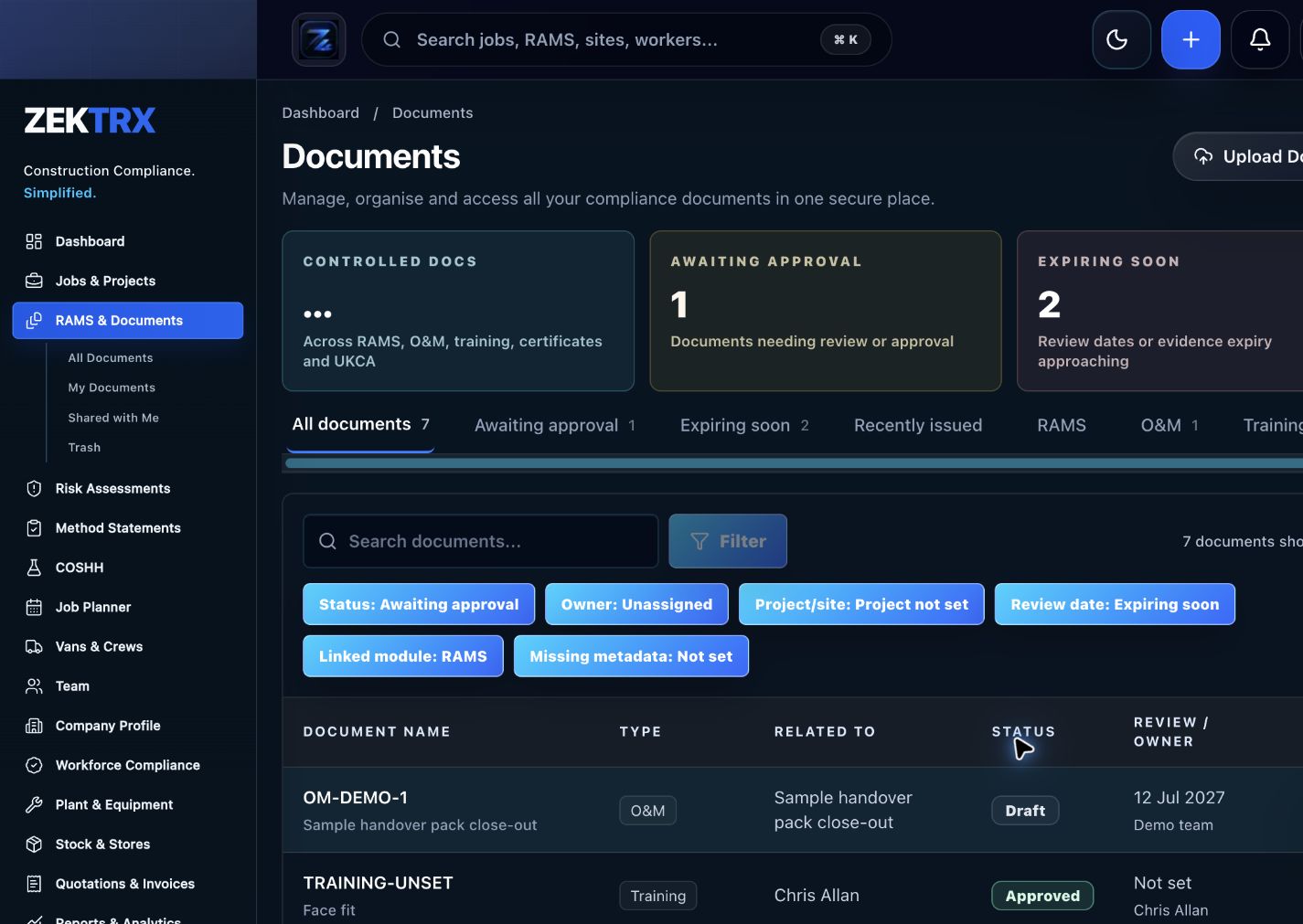
Control
The resource should point into controlled records, current versions, approvals and the proof teams need later.
Review
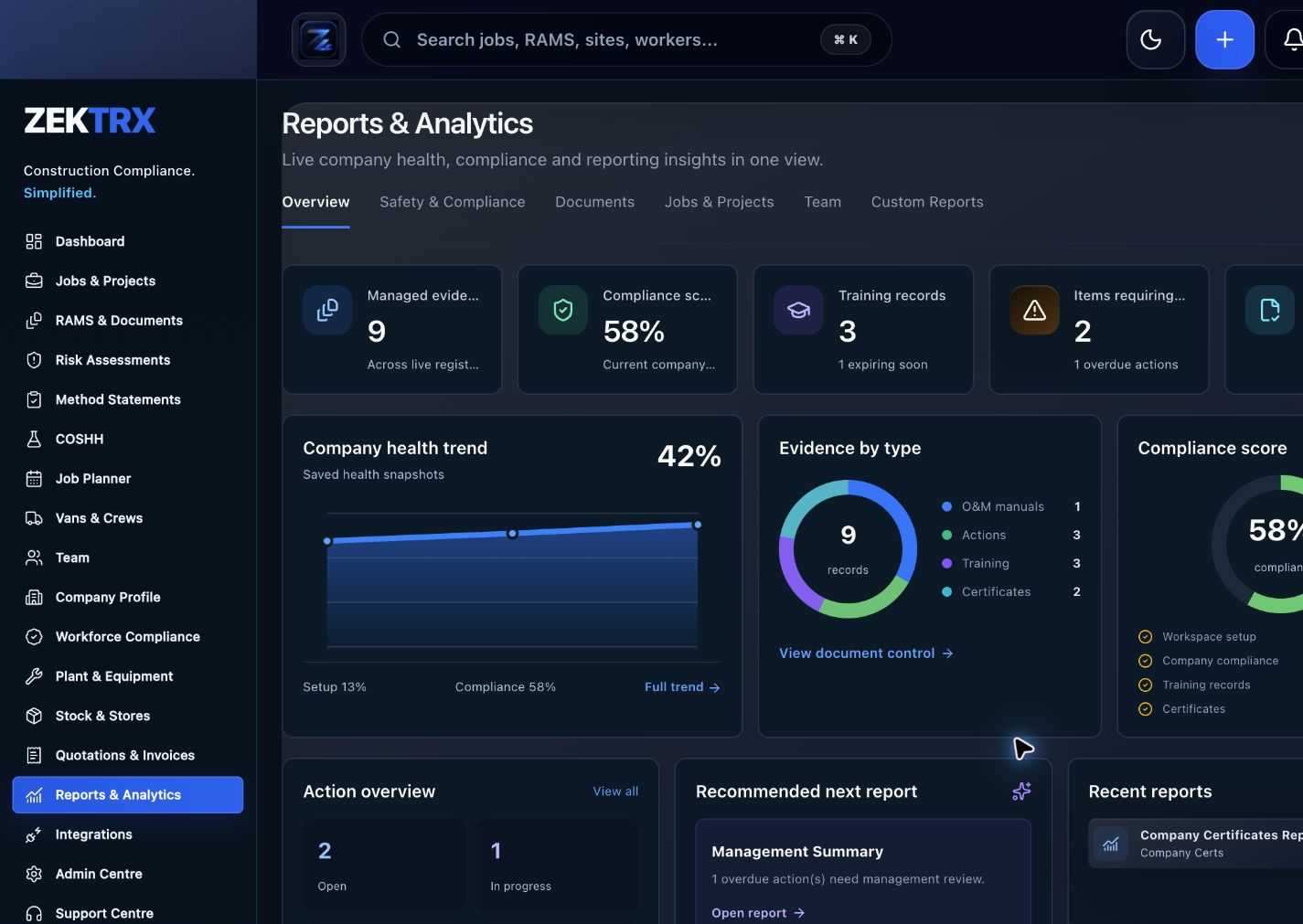
Reports and audit packs make the article practical after the work is complete, not just useful while reading.
Review the topic, reading time, editorial status and related Zektrx workflows before moving into the detailed guidance.
Topic
RAMS
Reading path
5 article sections
Review status
Published 30 June 2026
Connected links
Method Statement Software
Method statement software should make the planned sequence of work clear, reviewed and controlled. It should explain how the task will be carried out, which controls apply, who is responsible and what evidence is needed before and during the work.
Templates save time, but method statements should still reflect the real job. Review access, sequence, plant, materials, interfaces with other trades, supervision and emergency arrangements before issue. If a template is reused without review, the document can look complete while missing the actual site conditions.
Software should make reuse controlled: copy the right baseline, require review, keep revision history and preserve the evidence of what was issued.
A method statement is weaker when it is detached from the risk assessment. Teams should be able to see the risk controls that support each sequence of work and the evidence that confirms workers were briefed.
Zektrx links Method Statement Software, RAMS Software, templates, client comments, revisions and operative sign-off in one controlled workflow.
Use the Method Statement Template or read the Method Statement Template Setup Guide.
Related Zektrx workflow
Put it into practice
Start with the £5 for 14 days trial, then connect RAMS, jobs, stock, documents, records and reporting in one place.
1. Learn
Review what a risk assessment method statement app should manage, from RAMS drafting to approvals, signatures, revisions and site evidence.
A RAMS app guide for contractors creating, reviewing, issuing, signing and storing RAMS records across office and site workflows.
A practical buyer guide to RAMS software features including templates, reviews, signatures, revisions, evidence and reporting.
2. Use
Estimate hand-arm vibration A(8) exposure from vibration magnitude and trigger time. Free online tool for UK construction and trade teams.
Check ladder angle and vertical reach using ladder length and wall distance. Free online tool for UK construction and trade teams.
Create a simple manual handling risk score from load, frequency, distance and twisting. Free online tool for UK construction and trade teams.
3. Automate
Create, review and manage RAMS, method statements, signatures and evidence.
Generate task-ready RAMS from reusable templates and project context.
Standardise method statements and keep revisions connected to site work.
4. Start
Turn hazards, controls, owners, reviews and evidence into a controlled risk assessment workflow.
Create Risk AssessmentRelated Guides
Review what a risk assessment method statement app should manage, from RAMS drafting to approvals, signatures, revisions and site evidence.
A RAMS app guide for contractors creating, reviewing, issuing, signing and storing RAMS records across office and site workflows.
A practical buyer guide to RAMS software features including templates, reviews, signatures, revisions, evidence and reporting.
Related Calculators
Estimate hand-arm vibration A(8) exposure from vibration magnitude and trigger time. Free online tool for UK construction and trade teams.
Check ladder angle and vertical reach using ladder length and wall distance. Free online tool for UK construction and trade teams.
Create a simple manual handling risk score from load, frequency, distance and twisting. Free online tool for UK construction and trade teams.
Related Templates
A controlled structure for task hazards, method statement steps, controls, signatures and review evidence.
Plan the safe sequence of work, people, plant, materials, controls and hold points. Free printable construction template from Zektrx.
Identify hazards, people at risk, existing controls, further actions and review dates. Free printable construction template from Zektrx.
Related Features
Create, review and manage RAMS, method statements, signatures and evidence.
Generate task-ready RAMS from reusable templates and project context.
Standardise method statements and keep revisions connected to site work.
Related Industries
Electrical contractor RAMS, permits, testing evidence, drawings, site records and handover packs. One platform for documents, evidence and compliance.
Mechanical contractor RAMS, permits, plant records, drawings, inspections and handover workflows. One platform for documents, evidence and compliance.
Scaffolding contractor RAMS, inspections, handover certificates, permits, photos and site evidence. One platform for documents, evidence and compliance.
Related Comparisons
A practical buyer guide for choosing RAMS software that supports risk assessments, method statements, revisions, signatures and site evidence.
Compare Zektrx with paper RAMS and Word/PDF RAMS packs for contractors that need signatures, revisions, review evidence and site acceptance.
Compare Zektrx with SafetyCulture for contractors that need inspections plus RAMS, permits, documents, actions, site diaries and construction evidence packs.
Related FAQs
Yes. Create a free Zektrx account to turn the printable structure into reusable RAMS records.
From RAMS Template
Yes. Review RAMS against the actual site, task, people, equipment and controls.
From RAMS Template
Look for reusable templates, version control, review ownership, signatures, evidence links and reporting.
From Best RAMS Software
Usually not. RAMS need to be reviewed, accepted, revised and evidenced against real work.
From Best RAMS Software
This resource is for contractor, site, compliance and operations teams reviewing method statement software guide for contractors and deciding which records should become controlled workflows.
Yes. Zektrx is designed to turn recurring construction checklists, documents, actions, signatures and evidence into connected workflows.
No. Use this as practical workflow guidance and keep competent legal, safety, engineering or site-specific review where required.